“Bless the Lord, O my soul, and all that is within me, bless his holy name!” - Psalm 103:1
I recently did an experiment with two of my young daughters. I’m a big “start ‘em young” kind of parent (for better or worse), and we’ve been doing some music appreciation together. On this particular day I wanted to illustrate for them the power of music in movies.
I showed them a couple different epic movie scenes, first without the music and then with the music. When we watched without the music, they initially laughed at the silliness of it before settling into a bored quiet. I added the music back, and they became glued to the screen.
One scene I chose was from a movie they’ve never seen (yes, I feel the need to clarify that in order to protect my credibility as a parent). It’s the moment in Jurassic Park where the main characters see the magnificent creatures they have dedicated their lives to studying in the flesh for the first time. Real, breathing, giant brachiosauruses walk by. In the film, the dinosaurs first appear offscreen, so the characters see them before you do. You see each of them slowly look up one-by-one, stunned. Without the music, you’re more confused than intrigued. And once the camera shifts, it’s an underwhelming clarification. But with John William’s masterful score included? You feel the suspense on each of their faces. You sense something amazing has captured their attention. You have a growing impatience for the looming reveal. And once you see the dinosaurs, the music reaches its apex and you're swept along into the wonder.
Music has a way of moving us. It tugs at us, invites us someplace, and then takes us on a journey there. That’s how God designed it.
The Emotional Power of Singing
Martin Luther had this in mind when he wrote, “Music is to be praised as second only to the Word of God because by her are all the emotions swayed. Nothing on earth is more mighty to make the sad cheerful and the cheerful sad, to hearten the downcast, mellow the arrogant, temper the exuberant, or calm the vengeful.”
We live in a time where mainstream forms and practices have widely transformed the congregational singing moment into an atmosphere for surface-level emotional hype and excess. This leads to shallow discipleship and ultimately shallow faith. The kind that Jesus warns dies under hardship (Matthew 13). In light of this, many of us have rightly called for a revived priority of spiritual formation in our singing over emotional expression. I’m grateful for this correction. Yet I wonder if we are in danger of diminishing the proper place of feelings in corporate worship.
Throughout Scripture, God connects singing praise directly to our inner selves. Ephesians 5:19 instructs believers to “make melody to the Lord with your heart.” And in Psalm 103:1, David exhorts his soul and all that is within him to “bless the Lord.” God wants us to sing because it is a physical act that opens up our hearts to him.
Worship As Emotional Formation
Every believer needs heart-level formation. We are not computer processors. We are emotional beings who need God and his truth to touch us on an emotional level. God wants to make our hearts—the seat of our feelings and affections—a place where he reigns supreme.
I often hear people talk about worship as expressing our emotions to God, and I don’t think that’s wrong. Psalm 62:8 calls us to “pour out your hearts to God.” However, I don’t believe that is the ultimate objective for our emotions on Sundays. While our worship is in part an offering of what is inside us to God, it doesn't terminate there. Worship is an invitation from God to let him transform what is inside us, through his Word and by the power of his Spirit.
That is why Paul says, “Let the word of Christ dwell in you richly.” How? By “singing psalms and hymns and spiritual songs, with thankfulness in your hearts to God” (Colossians 3:16). Essentially, Paul is saying that singing from the heart gets God’s word deep down into every part of us—like the flavor in a good smoked Texas brisket. And when God’s word gets into us, we change! Put another way, singing God’s truth from the heart forms the heart.
How Are We Singing?
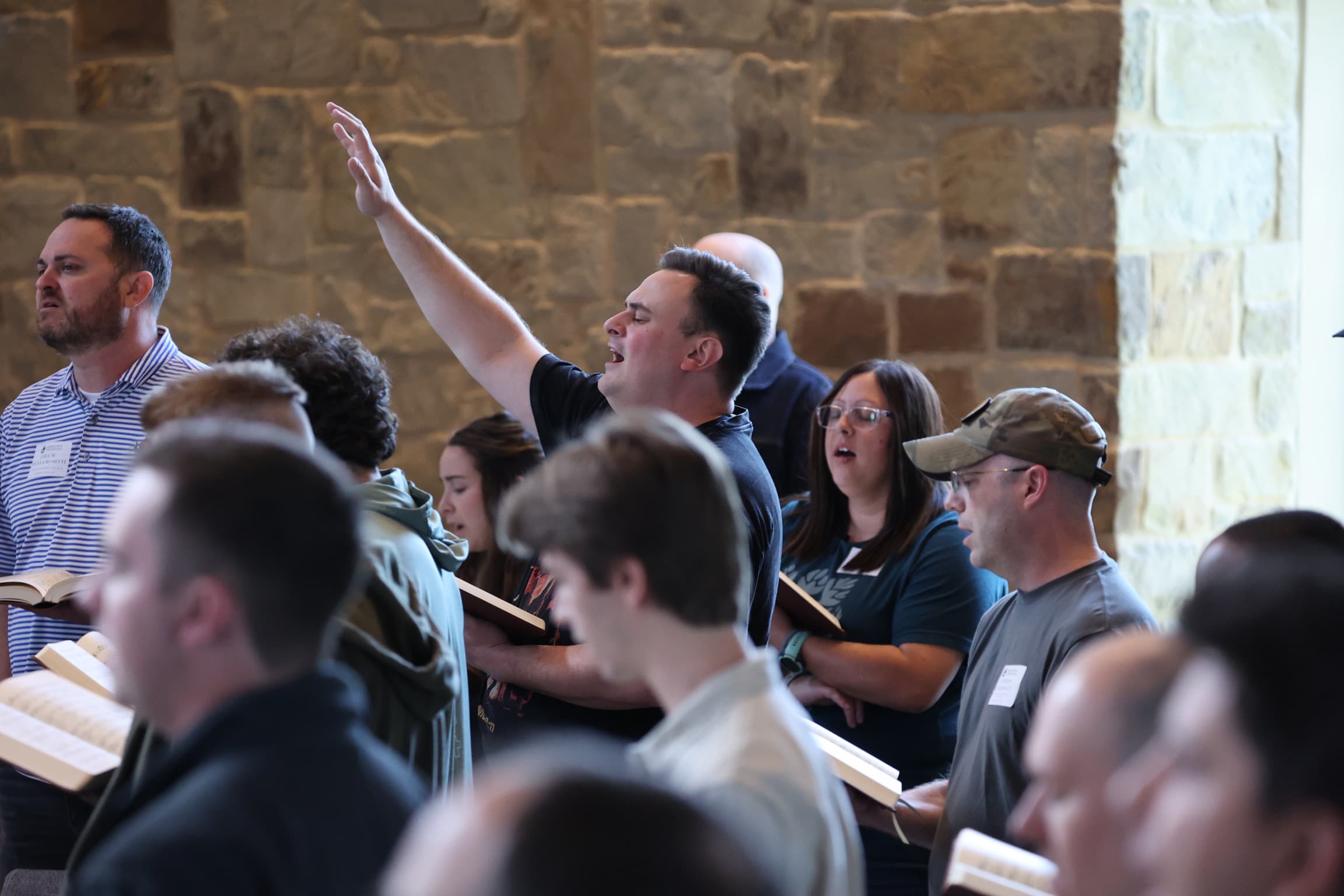
So how does this work? Well, I can show up on any given Sunday with all kinds of feelings. I may be discouraged or joyful, or just tired (remember my kids?). I find that, however I am feeling temporarily, when I am willing to jump feet first into the singing on Sunday morning—voice loud, hands raised—and rejoice in the truth of God, my heart is quick to follow along. This practice in turn forms my heart so that it is much more ready to rejoice in Christ come Monday. Or when I lead my heart to lament sin and marvel at Calvary through a song on Sunday—whether a particular sin was weighing on me when I came in or not—I have a deeper disdain for sin when I need to fight it on Tuesday.
Good songs help impress the truths of God deep into our hearts. This is why an opponent of Luther’s once said, “The hymns of Luther killed more souls than his sermons.” But what good do the songs do if we don’t truly sing them with our hearts? How we sing—not just what we sing—forms us.
So this Sunday, however we feel, let’s come eager to participate. Eager to sing truth and allow our hearts to get swept up. Eagerly inviting our congregations to do the same. Then let’s see what the Lord does.